
On This Page
Over the past five years, unmanned aerial systems have moved from niche military programs to a central component of modern operations. Recent conflicts have acted as a powerful accelerator, compressing development cycles that used to span years into months, and sometimes weeks. New actors have emerged, agile startups and fast-growing companies bringing civilian technologies into the military field at unprecedented speed. Tactical units now iterate directly on the battlefield, creating a pace of innovation the defense industry has not seen in decades. The drone landscape has never evolved so fast.
Artificial intelligence has been a key driver of this acceleration. Lightweight visual recognition models embedded directly in devices now provide drones with powerful autonomous capabilities, from target identification to navigation in GPS-denied environments. More recently, advances in continuous learning open new perspectives: models that adapt to evolving environments in real time, with minimal hardware overhead, a critical feature for low-cost tactical UAVs operating far from any infrastructure. This convergence of AI and unmanned systems is opening new operational possibilities, while simultaneously expanding the attack surface exponentially.
A rapidly expanding attack surface
As drones grow smarter and more connected, they become attractive targets. The threats are diverse and concrete: sensitive data interception, such as the positions of tactical units or reconnaissance imagery; adversarial attacks designed to poison or deceive embedded AI models; unauthorized access to command and control channels; and in the most severe scenarios, full drone hijacking. In environments where the stakes are operational and human, none of these risks can be treated as acceptable.
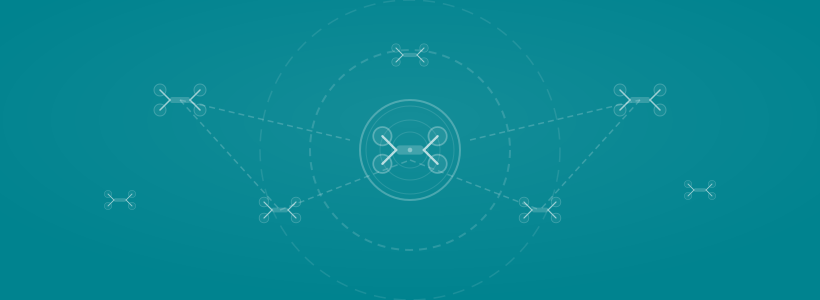
Beyond individual devices, modern drone deployments increasingly rely on collaborative architectures: hundreds of devices communicating and sharing data in real time, forming what is often referred to as a combat cloud. This distributed model amplifies both the operational value and the security challenges. Protecting the integrity and confidentiality of communications across such a network, while maintaining low latency and high throughput, requires purpose-built solutions.
Addressing these threats requires more than standard cybersecurity practices. Drones operate under strict constraints: limited computing resources, intermittent and heterogeneous network connectivity, and the need to communicate securely across a large and dynamic fleet. Security solutions must be designed for these realities from the ground up.
Leanear’s approach
At Leanear, we have designed secure communication solutions specifically adapted to these constraints, aligned with NATO’s Data-Centric Security orientations. Our cryptographic protocols enable messages to be encrypted once to many recipients, with fine-grained access control enforced at the cryptographic level. Role-based and attribute-based policies allow RBAC and ABAC to be enforced directly in the cryptographic layer, ensuring that each device, operator, or unit accesses only what it is authorized to, dynamically and without performance overhead.
Post-quantum resistance is built in by design, anticipating the next generation of threats. Our implementation in Rust reinforces robustness and performance, while ensuring portability across a wide range of hardware and network environments, from military-grade systems to commercial off-the-shelf components. Key management and device integration remain flexible, adapting to mission-specific scenarios including the seamless onboarding of new devices mid-mission, a critical capability in fast-moving operational contexts.
Opening new ground
The pace of innovation in unmanned systems shows no sign of slowing. As AI models become more capable and drone deployments more distributed, the security requirements will only grow more demanding. Our approach is built to scale with this evolution, making no trade-off between confidentiality, integrity, performance, and operational flexibility. For drone manufacturers and AI software developers operating in this space, security can become a differentiator rather than a constraint, and a foundation for the next generation of collaborative, resilient, and sovereign drone architectures.